Image Map

Monday, February 10, 2020

Getting Your Students to Read at Home and Enjoy It!


Reading at home is important. This is something we, as educators, know. We've all seen the chart about Student A, Student B, and Student C (recreated below).

(Sources: Here and Here)

By reading 20 minutes a night, Student A is exposed to 1,720,000 more words than their peer who reads an average of 1 minute per night. That statistic is alarming. Another statistic notes that when students are read-aloud to at home, it puts them a school-year ahead of their peers who are not read aloud to regularly.

So many teachers encourage reading at home, and some even make it mandatory. But how can we make it FUN AND ENJOYABLE? Well, I have some suggestions for you!

PROVIDE QUALITY, APPROPRIATE BOOKS FOR YOUR STUDENTS TO READ
Hands down, the most important way to get your students reading at home is to make sure they have appropriate, quality books that appeal to them. Maybe where you teach, students already have these books at home. But if they don't, make it your mission to provide them with books they will read. Work with the librarian to make sure students are checking out books they will actually read. Sign-up for extra library time, purchase books at thrift stores, garage sales, online resale groups, or Thrift Books or Amazon. Create a Donor's Choose project asking for books for your students. Write to book stores. Do whatever it takes to provide your students with books they will read.

Representation is also extremely important to children reading books. They want to read books with characters that look like they do. If you have a diverse student population, keep that in mind when resourcing books for your students.

I often share my favorite children's books on Instagram. Follow me! @halleacrossthehall

MODEL A LOVE OF READING
Again, maybe some of your students have parents or older siblings at home who are reading in their presence. But maybe they don't. Make it your mission to show your students that you love reading. Display the book you are currently reading, read it front of them, and talk about your love for reading. This is something they will take home with them when it's modeled for them.

MAKE IT OPTIONAL
We all have busy nights, bad days, and important events that take us away from our daily schedules. When you mandate something it's practically guaranteed that it will become a chore. When you give your students the option to read, it becomes a choice. A choice they will hopefully make, especially when you implement some of the suggestions in this post.

Can't completely let go of the reigns regarding reading? Instead of making it a set amount of time each night, make it a goal to read a certain amount of books or minutes by the week or month's end, or make it a challenge. My Reading Challenges resource allows you to make reading a requirement OR challenge (I suggest the latter :)).

These monthly reading challenges make reading fun, not a chore.

There are also challenges to send home on fall, winter, spring, and summer break!


PROVIDE A BUDDY
Stuffed animals are easy to come by for low prices. Send home a classroom reading buddy with a different student each week or get enough buddies that each student can have their own. Create a booklet or necklace with questions "the buddy" can ask students about their book.

Students could even draw their own buddy and use it as a bookmark.

GET PARENTS IN ON READING
Reading at home with parents can be a double-edged sword, especially with students who are just learning how to read. Well-meaning parents may confuse their child when the student struggles with words. I once overheard an old sister trying to teach her brother how to read "here". It was cringeworthy to hear her explanation, even though she was coming from a good place.

So what can parents do? Read TO their children. If you have a reading log for homework, parents reading to their children should also count. Every single page of my Reading Challenges includes a parent reading to their child as an option. Children are seeing their parents read and fluent reading is being modeled to students.

For students who are just learning how to read, or struggling to read, tell them that reading the pictures to their parents is also an option.

MAKE IT FUN
Nothing will make reading fun for students if they don't have appropriate books, but provided you've addressed #1, there are so many ways to add a fun twist to student reading.

These Reading Challenges have lots of fun options for students to get their fill of reading: read with a hat on, read under the table, read with a flashlight, read a cookie recipe then make it! When I started providing these fun twists to get my students reading, I noticed such a difference in nightly reading participation. I suggest adding a fun twist to your required or optional reading :) Before you know it, students will anxiously turn in their reading challenges asking for their next one.


I hope some of these ideas help you to implement a successful at home reading program in your classroom. Do you have any other ideas teachers or parents could use to get their kids reading?

Want to try a sample of my Reading Challenges for the Whole Year? Enter your email below and a FREE reading challenge sheet will be sent straight to your inbox!

Thursday, February 21, 2019

Comprehension Skills for our Younger Learners

Some might call me the Queen of Picture Books.

Ok-I think only I call myself that. But, I have a point here. My point is that I love, I live for, I thrive off of children's books. I'm just as happy in the children's section of a book store as I am at a nice dinner or the beach.

And I share my love for children's books with my students and my children. There is no doubt that all the kids in my life know of my affinity for children's books.

At home we eat them up like candy. At school, we make time for them every single day. We use them to teach and reinforce concepts like character traits, plot, summarizing, fact and opinion, grammar skills, and inter-disciplinary skills. I love using them to model reading comprehension skills with my youngest learners.

But I like to follow up with something more concrete too. I like to see evidence of their mastery of comprehension skills. That's why, along with picture books, I use reading passages with my students to reinforce comprehension skills.

I started writing my own passages for first graders when I couldn't find what I was looking for on Teachers Pay Teachers. A lot of what I was finding featured passages broken down by phonetic skills only. And while I think that's great and can serve a purpose, it wasn't serving mine.

Little Learners was born when I started writing seasonal, high-interest passages for my own intervention students. The passages were written for first graders, but I find them effective for my struggling second graders as well.


The passages start simple and build in complexity and difficulty as the year goes on. Above is an example of an August passage. The text is simple and repetitive.


Here is a passage from the April Edition of Little Learners Comprehension. Notice how the text got more complex?

Because time is always an issue for teachers, I wanted something that would incorporate grammar and phonetic skills, but I didn't want those types of skills to dictate the whole passage. So, I added a "Find It"section that incorporates phonics, grammar, and extra story elements.

Kids love any chance to use crayons or markers, so I added a drawing component. Psssst...it's actually a comprehension question in disguise.

And our younger learners need opportunities to respond to questions in writing. There's no circling their answers in different color crayons here. I think it's an awesome strategy for locating information in text and I use it. I even have them do it from time to time with my passages. But they are ALWAYS WRITING in addition to locating information.

And lastly, I want them to connect to the story or look at it deeper. Most of my passages feature a "Write About It" section. Sometimes the heading is called "Infer It" or "Connect It", but it always has students looking deeper into the text.

I love that I get to tackle all of these concepts with a SHORT passage written just for my youngest learners. We get to do all of the above skills on ONE PAGE! And my students are almost always fans of the stories on the passages (there's always one, right? hehehe)

Want to try a free sample of my Little Learners Comprehension Passages? Sign up below to have them emailed to you.


Already know you want them? Click HERE to grab them from Teachers Pay Teachers.


Happy Teaching,

Halle

Thursday, July 28, 2016

5 Ways I Use Punch Cards in My Classroom

Every summer about this time, I start to get the itch. You know, what will I add/subtract/continue to do in my classroom this year?

This year I'm changing a lot because it will only be my 2nd year in the role of a reading intervention teacher. Last year was all about learning the ropes of my new position and my new school. I was just treading water. I'd like to think this year I know a little more and I can offer a lot more to my position.

One thing I'm adding is punch cards! I plan to use these punch cards in different ways for each of my groups, grades K-2, because their needs are different too!

There are so many ways to use punch cards in your classroom, and students love them!

Read on to see how I'm using punch cards this year, plus a few ideas for classroom teachers too!

There are so many amazing ways to punch cards in your classroom! Letting students choose their own punch cards makes it extra fun!


I will be using punch cards to monitor reading with my 1st and 2nd graders. I will send home punch cards in their take-home book baggies. Parents will initial for every book read, then I will punch the image to show I've checked it. The monthly themes of my punch cards add an extra initiative to their at-home reading and it's such an easy way to keep track of who is reading regularly (their nightly reading is optional from me). I will add empty punch cards to their student file and come progress report time I have an instant image of who was reading regularly and who I can recommend more at-home reading to.

Other Ways to Use Them to Monitor Reading...
Have older students reading chapter books, or want to stress quality reading, not quantity? Have parents initial for every 10 minutes read, or have students punch during Daily 5 for every 5, 10, 15 minutes read to focus on stamina.

There are so many amazing ways to punch cards in your classroom! Letting students choose their own punch cards makes it extra fun!

Punch cards as incentives will mostly be used with my little K friends, although I am not above breaking them out for my older friends as well. My time with my littles ones is precious, as I am spread out between 8-10 classes. And we all know how short of an attention span our little ones have, so I will be using my punch cards as a way to keep them focused for as long as possible.

We will be punching for coming to groups quickly, staying on task, completing a task or mini-assignment, being a helpful friend to others in group, and extra effort. I will be punching away. Punches alone are the perfect incentive. They do not need to be tied to extra prizes. Just saying, "Wow, Brady, you earned 3 punches today!!!" is enough for my little friends. I will also let them pick out their own punch cards instead of using them seasonally because, why not?

Other Ways to Use Them as Incentives...
Independently or Whole Class: you might not want an extra thing to use with your whole class, or you might want a collective way to inspire your kids. There are no rules with these things!
Use them for behavior, at specials times only (the gym teacher gives a punch or she doesn't: EASY!), at dismissal (I wish I thought to use these my first year when dismissal was a HOT MESS for poor first year me!), during arrival, etc, etc, etc

There are so many amazing ways to punch cards in your classroom! Letting students choose their own punch cards makes it extra fun!

I will have a separate punch card for each of my reading groups (there's so many to choose from)! Anytime my students get a compliment from someone else, they will receive a punch on their group card. There are plenty of opportunities for compliments: we have to walk down to my classroom and back and we share a classroom with another intervention teacher. I also plan on punching the group's card if any of my students' teachers come to me with a compliment about progress in class. Each time a group's punch card is filled, I will have a fun reward, like no shoes or gum in small groups.

Using the punch cards this way is important for me because, as a non-classroom teacher, I struggle with the amount of time to spend on procedures and routines when my primary role is an interventionist. Classroom management has always been one of my strengths and I found it was more difficult this past year not doing my usual beginning of the year lessons on behavior, procedures, and routines. Punch cards will offer a great assist in my management program as pull-out teacher.

There are so many amazing ways to punch cards in your classroom! Letting students choose their own punch cards makes it extra fun!

Punch cards are great for classroom teachers to use to monitor and track homework. During my last few years as a classroom teacher we had "choice homework"...90% of our homework was by choice and the remaining 10% had to be done each week. I wish I'd had punch cards during those last few years. Students would receive a punch for the required homework and a bonus punch for any choice homework also completed.

Punch cards work great for any homework program, though. An easy, student-centered way, to monitor homework completion.

There are so many amazing ways to punch cards in your classroom! Letting students choose their own punch cards makes it extra fun!

Do you do timed tests in your classroom? AR? Xtra Math? Any skills you assess using progress monitoring would be a great way to use punch cards. Have students keep individual goals and write the steps for getting to that goal? They can punch their card every time they complete a step along the way. Bonus for letting students choose and punch their own cards! This will really help them take ownership of their own work and goals.

As you can see, I've really thought through how I'm going to use my punch cards this year! Now not the next 23,982 things I want to work on for the next school-year!

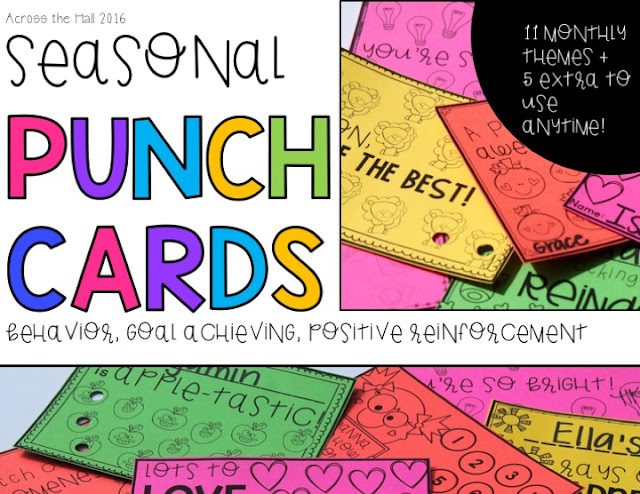
If you're interested in using punch cards in your classroom or small groups this year, you can grab them from TpT by clicking the picture below. They include a theme for each month of the school-year (some have two themes  because I couldn't decide), plus 5 extra sets for even more student choices! Black ink, so they're printer friendly...print on bright cardstock and you're good to go!

There are so many amazing ways to punch cards in your classroom! Letting students choose their own punch cards makes it extra fun!


Have other suggestions for how to use punch cards? Leave them below!

Happy Teaching, Friends!

Tuesday, July 26, 2016

Prepping and Planning for Guided Reading


Hi Friends,

I'm here today with the first post in what I hope will be a really helpful and successful series on how I run my small groups and a reading/language arts intervention teacher in grades k-2. At the end of this post, I've included a freebie to help you get started with the planning of your own small group instruction!

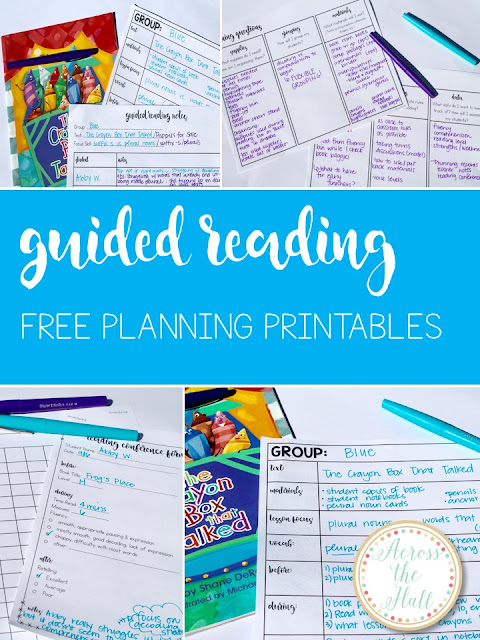
Free printables to make planning guided reading and small group lessons a breeze!


In my school, my role is to work with the top tier of students who are performing below grade level in reading and language arts (Tier II RTI). We have two reading specialists who work with our students who need a higher level of intervention (Tier III RTI), and they use our schools' LLI kits.

LLI is an amazing program, but since I do not meet with students everyday, I can't use it authentically, and therefore, it's up to me to make sure I'm using a variety of resources to meet my students' needs. I meet with students 3x a week for about 35 minutes each. My schedule is actually a lot like it was during guided reading when I was a classroom teacher. Because of this, I feel like my guided reading posts are (hopefully) just as beneficial to classroom teachers as they are to intervention teachers.

Today's post is all about how I prep and plan for my small groups. I use a variety of planning sheets to make sure I am planning every part of our lesson and making the most of our time together. Future posts will detail the resources I use for each grade (k,1,2), as well as how I run my small group time for each grade level.

Prior to my position as an intervention teacher, I was not a planner. I didn't need to be. We had a basal, and I was confident in my teaching style. While I still consider myself flexible and more of a free spirited teacher, not planning is not an option when my time with my littles is so precious. And so, my planning sheets were born!

In the summer, or during the first few weeks of school, I use my planning questions sheets to make sure my guided reading area is set-up the way I need it to be. I want to make sure I have all the materials I need handy. These questions also help me identify possible problems or issues before they pop-up during a lesson. Last year, I looked back at my planning sheets about halfway through the year, and made adjustments to make my small group time even more effective.
Free printables to make planning guided reading and small group lessons a breeze!

When it comes time to actually plan my instruction, I try to plan 2 weeks at a time This just gives me a little more time between planning and it seems a little less tedious this way. I make sure to plan what resource(s) I will use for each group, a focus lesson (based on notes and data from previous lessons), and the before, during, and after of each lesson. I didn't start out planning all 3 components and before I knew it I was winging at least one part of each group's lesson. With time being so precious with each group, I knew that wasn't really an option.


For texts, I use a variety of different resources available to me. I usually start out in our book room, which is pretty well stocked. I make sure to look for high-interest texts, and try to correlate them to seasons and holidays whenever possible. One problem with the book room is that classroom teachers are also using it for their own guided reading groups, and I really want to avoid duplicating a guided reading lesson a student has already been a part of.

I also rely heavily on Teachers Pay Teachers. I will go into this further when I post about each grade level I work with, but a huge go-to for me is my reading comprehension passages. They're perfect for close reading lessons, as well as teaching my students to go back into the text to find their answer. I love that they're seasonal, so if I can't find a book on MLK Jr. in the book room, I have a passage to use instead.

Another resource of my own that I use for my 1st and 2nd graders are my Grab and Go Comprehension Packs. They each feature a fiction and non-fiction passage with comprehension questions built in. Each pack also has a focus lesson and activity so that part of my planning is already done. They are the perfect size for meeting with students 3-4 times a week as well.
Free printables to make planning guided reading and small group lessons a breeze!
My "before" lesson is usually a phonics activity that takes all of 5 minutes to play. I love starting with games because it gets my students excited and in a frame of mind that reading can be fun! Phonics games are also great when the included phonics lesson with whatever text we're using isn't something I really want address yet, or a fabulous way to tie in that book's phonics lesson.

The "during" part of my planning is where the bulk of the lesson occurs. This includes previewing the text, introducing/reviewing the focus skill, and the reading of the text. I make sure to budget about 20 minutes for this part of the lesson.

During this time I am taking notes while my students are reading to me. I include what level the text is (if applicable), areas they're struggling, and where they are making strides. These notes help me plan my focus skills and strategies for upcoming lessons.
Free printables to make planning guided reading and small group lessons a breeze!

The "after" part of my planning sheet is how I am going to wrap up the lesson. Exit ticket, discussion, adding to our anchor chart, all happen here. Just like the "before" part of my small group instruction, this takes about 5 minutes. This leaves me 5 minutes to check book baggies or just check in with my students and see how their day is going.

I also do individual reading conferences with my students. I shoot for about 2 a month for each child. I also do a lot of reading conferences when I push into other classrooms. I make sure to keep the reading conference notes in a separate section of my intervention binder for when I am working on progress reports or meeting with a parent. For me, reading conference notes are the most authentic way of seeing how my students are progressing. I get to see what skills and strategies they are using independently, as well as how well they are comprehending what they're reading.

I've compiled all of the sheets included in this post into a "Guided Reading Starter Kit", which you can download for FREE here. I would really appreciate some feedback if you download it and use it in your own classroom.

Free printables to make planning guided reading and small group lessons a breeze!


Stay tuned for the next part of my Small Group Series. I will be sharing how I run my kindergarten small groups at this point in the school-year.

Happy Teaching,

Sunday, March 20, 2016

A Few St. Paddy's Freebies

Hi Friends!

I posted a fun St. Paddy's Day inferring activity on the eve of St. Patrick's Day and since most of you are probably ahead of the game {unlike me}, I wanted to share it again here so you can save it for next year.

Click the picture to grab it:


At some point I plan on updating this freebie to be more like my other inferring packs and then it will no longer be free, so grab it now.

PS: At some point for me usually means in about 1398 years ;)

I also posted a picture of  the little treat I gave to my kiddos and a few people requested them on Instagram and Facebook, so I'm posting those here too. I also added the tag I attached to bags of Skittles Ella gave her neighborhood friends.

Click the pictures to grab the tags.


Print and go! St. Patrick’s Day printable freebie-a quick gift for the classroom or friends.


I planned on adding Rolos, but when I couldn't find them I decided Reese's did the trick :)

Hope you can add these to your digital filing cabinet for next year!

Enjoy your day :)

Monday, December 7, 2015

My Pet Reindeer

Hi Friends!

Are you counting down the days until winter break? Me too #about15togo

As much as I cannot wait for a solid two weeks at home, where getting dressed is purely optional, I really do love this time of year at school. It's like holidays 24/7 for all of December for teachers. I mean there's books upon books dedicated to the holidays and we get to decorate our homes and our rooms! Okay, that's not always the funnest for some of us :)

I'm here today with a sweet little creativity unit I whipped up just in time for winter. It's all about adopting a pet reindeer, so it's tons of fun for Christmas, but it's also a lot of fun if holidays are a no-no in your school, but you still want to sprinkle a little cheer in your room!

In this unit, students adopt a pet reindeer and write all about it! There are tons of different writing papers and prompts to appeal to students of all ages, but the funnest writing activity comes in the form of a pet manual. You have to love the activities where students don't even realize they're doing work because they're having so much fun.

And if they get to use their imagination? Well, I'm ALL OVER THAT!

We're just getting this little unit started in my pull-out groups. Because I only have them for small periods of time a few times a week. I have to really break up the lessons.

We started by adopting a class reindeer we named Bernie. We talked about all the ways we could describe the way Bernie looked on the outside. Then, we read "Olive, the Other Reindeer". We talked about what skills and characteristics Olive had that made her a good reindeer.

We went back to our chart and added personality traits. I also asked them to think about their pets at home. How would they describe their personalities? We added a few of those suggestions to our cart as well.


{{Sorry our chart is a little wrinkly. I had an overzealous volunteer grab it for me!}}

That's as far as we got last week. This week we will use our characteristic planning sheet to plan out our own reindeer's personality and appearance. We'll use them to make our reindeer and finally to fill out our pet manual.

Lastly, my students will receive adoption certificates and they will officially be reindeer parents!

Here's a closer look at most of the components of "My Pet Reindeer"


This unit includes tracers for the pet reindeer. I plan on only giving my students tracers for the reindeer heads and possibly antlers because they need help with scale, but I want each students' reindeer to look different and be reflective of the characteristics I gave them.

I will post pictures once we finish them! I'm so excited to see the final result!

You can grab this little unit from my TpT store by clicking the cover image below:


Happy Holidays :)


Sunday, October 25, 2015

Halloween Round-Up: Freebies & Favorites

Hi Friends!

Just stopping in to share a few of my favorite Halloween activities for the Halloween week ahead (aka SURVIVAL WEEK)

The good news: they're all fun & educational
The great news: many of them are free!

First up: a freebie of my own made to accompany everyone's favorite Halloween book (okay, at least one of your favorite Halloween books): Room on the Broom.

This freebie features comprehension cards, sequencing, and cause and effect activities. Read more about what's included and grab it here.

Practicing dialogue with your kiddos? I have this fun freebie for a ghostly greeting bulletin board:


Okay, this one isn't free, but it's HANDS DOWN my students' favorite Halloween center that we do...and I do Halloween BIG in my room. Costume Clues is so much fun that your students don't even realize they're practicing their inferring skills (unless you tell them...in which case they'll still have so much fun).

Honestly. I wouldn't lead you astray...grab it here.

This fun activity from Jamie at 2nd Grade Stuff is also a crowd favorite:


Wanting some Halloween math activities?

I have a freebie or two for you:

This ghost bump is too cute. I seriously love this ghost clipart and look for a reason to use it every year:


And this freebie is fabulous for building number sense. So many options for how to use it:


I hope I was able to help you stock-up for this week of craziness! And remember, drop lots of hints about your favorite candy to your students...they'll bring them in to share with you. You deserve them for getting through this week :)


Sunday, October 11, 2015

New Look, New Name, New Giveaway!

Ok, can I start by just saying "SWOON" to my new blog design? I am in love with the new look. And it's all thanks to Becca over at Jumping Jax Designs! She actually designed my last blog too, but with a new job and a new blog focus, I felt change was in order.

So the new look: again, SWOON.

The new name? It's subtle. You probably didn't notice when you were admiring my new design, but I dropped the "in 2nd Grade" part. This is mostly because I don't just teach 2nd grade anymore. And also because I plan on bringing a little more of my "outside the classroom life" into my blog. For such a long time, I held back on writing about something that happened in my personal life, or talking about new things I found for my home, or a new recipe I tried b/c I felt like I HAD to focus on teaching. And while more personal things seeped into the blog, I was still limiting myself. Now I feel like I don't have to do that anymore.

Plus, I'm not just teaching 2nd grade anymore. My new position has me teaching language arts to grades K-2. That means more resources and lessons across a broader range of ages, grades, and abilities. I don't want someone who teaches kindergarten to come across my blog and turn away because it says 2nd grade. I'll have ideas for that person too now! Soon, I hope!

The general idea is that a great idea {or a laugh, or a what not-to-do} is across the hall. I hope you'll come along for this next step of my blogging journey.

And I FINALLY updated my "About Me" section. It was a just a tad bit outdated. Check it out while you're here.

Now to the good stuff:

In honor of my new name and my new look, I'm having a new giveaway!

Two giveaways actually!

The first is easy to enter, right here on the blog. Use the rafflecopter below to win $25 in resources from my TpT shop. It's super simple and super-fast!

The second giveaway is also really easy to enter. I'm hosting it over on instagram. I want to send you a few of my favorite things in honor of this blog now focusing on my life outside of teaching.  You can win...
*a THANKFUL banner from Target
*an adorable coffee mug from Target
*a Starbucks giftcard
*adorable days of the week pencils
*super-cute pumpkin candle from Target

Click the picture below to head to instagram and see how to enter there.


Both giveaways end on Saturday, October 17th!

Good luck, and thanks for following along!

a Rafflecopter giveaway

Monday, September 14, 2015

Changes


September is a month of new beginnings for many of us who head back to school during this month. But, boy, has September been a month of change for me a few years running.

September 2013: I was teaching second grade in the district I had worked for since I started my career as a teacher. No big changes other than a new class and a new superintendent.

September 2014: We welcomed Ella Grace into the world and EVERYTHING changed {for the better}. I put teaching on the back burner and became a stay at home mom for the entire school-year.

September 2015: I started a new job, in a new district, with a new title. {and my baby became a toddler...sigh...where does the time go?}

That's right, if you follow me on Instagram, you *may* have seen my subtle announcement that I have accepted a different position in a different district and I am pretty darn excited about it!

I will now be teaching Language Arts to grades K-2 as a pull-out teacher. My position is pretty new to the district and school where I now work. Because of this, I'm not quite sure what my responsibilities will be, what programs I will be using, etc.

I'm not quite sure what lies ahead, but I do know I made the right decision. I had contemplated not going back to work at all, and actually, for about two weeks over the summer that was the case. I resigned my former position without having anything else lined up. We were fine with me staying home a for a few years, but there was a small voice in my head telling me I wanted to be back in the classroom sooner rather than later. I started searching for part-time teaching positions and I found the posting for the district where I now work.

I am hopeful that my new position will offer me a deeper understanding of literacy and language arts in the primary grades, which will in turn lead me to creating resources for a variety of grade levels.

I am also hopeful it will create the work-home balance I was searching for when I applied for the job. Because the job is part-time, I get to devote more of myself to my family, friends, and home. I am excited to hopefully have the best of both worlds.

Because of these changes, my blog is undergoing a little bit of change as well. I will of course be blogging about all the things my new position entails: lessons, funny stories, products, and pictures. And I also hope to blog a little bit more about my personal life as well: parenting a toddler {again, sigh}, house/home/decor, favorite things, and just any little thing I want to!

I hope you will want to follow along :)

Keep an eye out for the new look, soon!

-Halle

Monday, August 17, 2015

Looking to Revamp Your Morning Work?


I've been teaching for 7 years now. I think back to how I started off: excited but unsure, eager yet apprehensive. It's amazing how teaching can be both extremely exciting and daunting at the same time. Especially for the fresh-faced college grads.

Looking back, I'm amazed at how many teaching practices I've kept since I started. I think this is mostly because I researched the heck out of routines, procedures, homework policies, reward systems, and morning meetings before I even had a classroom of my own. This was before Pinterest and teacher blogs, mind you. I was a big visitor the the A to Z teacher forums as well as Education World.

Remember those? They still exist, actually!

Anyways, something I've kept mostly the same for the last few years is Morning Work. Of course, every year it's been tweaked, but the general idea is the same. And it's probably because I absolutely love how we do morning work in our classroom

I guess I should mention now that I've had access to a SMART Board or projector since my second year of teaching, and I do morning work that way, but my routine could be adapted to your classroom if you're lacking that kind of technology.

I should also mention that this is nothing ground-breaking. I just took a pretty popular morning message idea and adapted it to the needs of my own classroom. {You know...what teachers have done since teaching began... :)}

When my students walk in our classroom in the morning, my morning message to them is on the board.


Students unpack, place their homework books and take-home folders on the back table, hang up their coats and bookbags and get to work. {I do not call them by group, they do this on their own time}.

Ok, so like I said, the morning message is on the board. Students read the message {with blanks} to themselves and then take out their Good Morning Notebooks. The message generally lets them know what we will be learning about that day and any important announcements {birthdays, special visitors, special events, etc}.

There are always a few blanks in the morning message. Students write the answers to those first. One answer per line to keep it neat. They DO NOT rewrite the whole message. #aintnobodygottimeforthat

What you do need time for: modeling, modeling, modeling. I'm not going to lie. This monring work routine does take a fair amount of work up front but it totally pays off. Just like anything worthwhile :)

This is one of my lower friends, but he has the most beautiful handwriting so I made a big stink and took pictures of this notebook!


The blanks are usually in place of days of the week, names of specials, and sight words. Sometimes I have a blank with a skill or concept from the day before so I can gage how well they remember the term {examples: compare/contrast, mental math, strategies, etc} For those kind of words, spelling is not important, but for days of the week, teacher and special names, and sight words, students correct their spelling when we go over the message.

Once students fill-in the blanks from the message, they move on to "below the line". I'm sure you could come up with a fancy term for this, I just never did!


"Below the line" is often just an extra question or task they need to complete before they are done with their morning work. It might be a set of math problems. It might be something they need to search for in the message itself {example: find the synonym for kind}, or it might tell them to grab a worksheet off the back table.
The "Below the Line" here asked students to write a sentence and draw a picture about what scientists do.
Here "below the line" was triple-digit addition problems.

What I love about "below the line" is that it allows me to be as flexible as I want to be regarding the amount of time I have to give for morning work. Say it's Monday morning and I need to check for Friday Folder signatures. I know it's going to take me a little longer than usual to go through their folders, so I come up with something a little more involved for morning work.  Say we're headed to an assembly 10 minutes after school starts and I need to squeeze in a morning meeting before we go, "Below the Line" for that day will be a really simple task so we can all move on quickly.

I'm not ever tied down to giving the same thing for morning work each day, yet my students still have a routine that allows me to get what I need done without fear of any disruptions. That's why I love it!

After a majority {or all on a good day} of my students finish their morning work, we head over to the carpet for morning meeting. When we head back from morning meeting, we fill out the morning message together. First, I choose a student who will read the morning message aloud. I do this first because I want them to have time to read it to themselves in their head so that when they read it to the class it's the smoothest read possible. I didn't do it that way when I first started doing morning work this way and reading the morning message could sometimes take FOREVER. I also call on students to fill in the blanks. They are allowed to pick whatever blank they want/is left when they get to the board.

Later in the year, I started adding a third component to morning work. I chose a clipart character to give the students a quick, additional task.


Like I said above, students are responsible for correcting sight words, names, months,and days of the week in their notebook. This gives them a reference to use when they are unsure of the spelling {something we talk a lot about at the beginning of the year}.

Do you differentiate morning work? Easy! Just give separate tasks for "below the line" work!

Think this kind of morning work routine would work well in your classroom? You're in luck! I'm providing you will a free morning work template to be used on your projector. It will be a Powerpoint file so that you can edit it. I won't be offering it in any other format at this time {sorry}. Click the picture below to grab it.


I also have a PDF file for you of the labels I use to put on the front of my students' "Good Morning Notebooks". You will need to print them on Avery shipping labels {6 labels to a sheet} or sticker paper. Click the picture below to grab them.


If you were looking for a way to switch up your morning work, I hope this helped!

Halle